

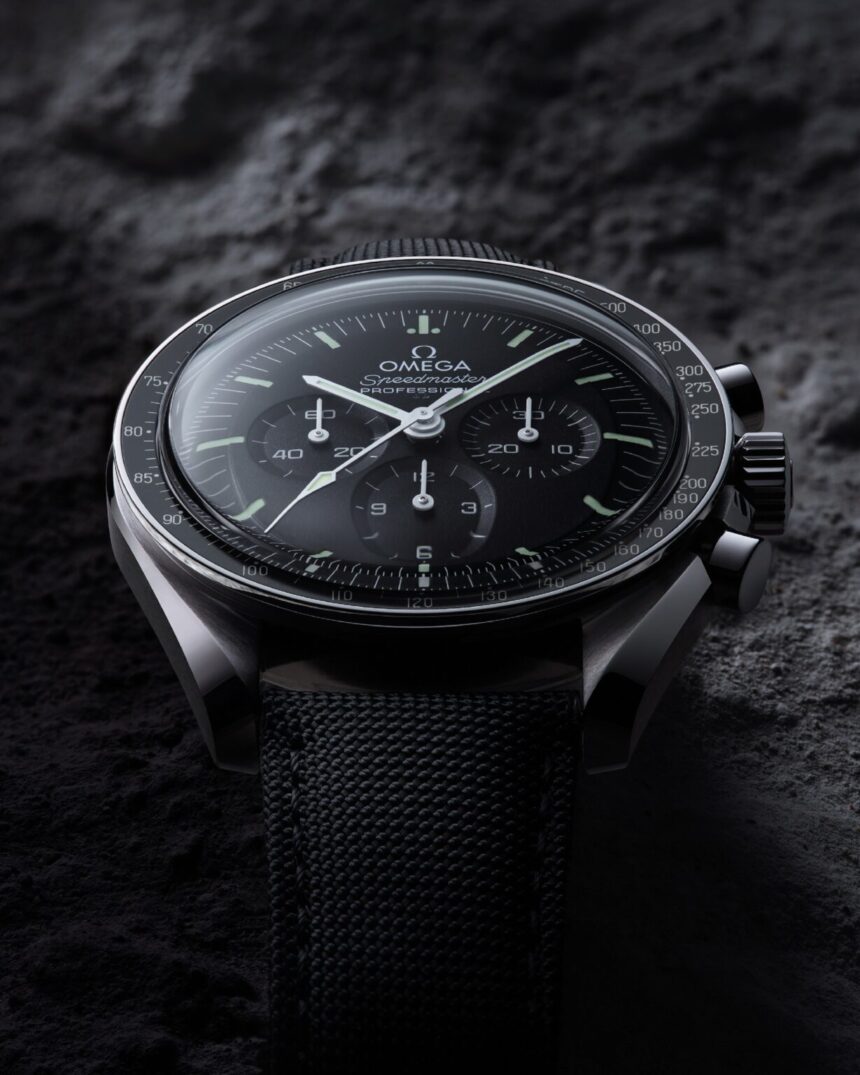
A Historic Moment in Human Achievement
In all history, it seems, few exemplary and eminent brands can claim to have a more authentic and relevant connection to the moon landing than OMEGA. OMEGA was a companion in one of mankind’s greatest achievements, and some say it is the lunar conquest that was not only a great triumph of science and engineering but was also one of the great stories of precision timekeeping. OMEGA was more than a mere watchmaker with respect to the Speedmaster, but a partnership of sorts—one that stood the test of time.
On July 21, 1969, at 02:56 Coordinated Universal Time, Neil Armstrong became the first human being to walk on another celestial body when he stepped onto the lunar surface. Buzz Aldrin followed moments later, and on his wrist was an OMEGA Speedmaster, a watch put through the most extreme conditions known to humanity and which now evokes tales of exploration and human ambition.
The Speedmaster on the Lunar Surface
With the Speedmaster being left behind as an auxiliary timing device by Neil Armstrong, the watch worn by Buzz Aldrin represents the first watch worn on the lunar surface. Pictures engraved in our collective memory are those of Aldrin standing on the moon with the Speedmaster glaring on his wrist. They signify bravery, ingenuity, and a dire need for reliability in an environment where every second counted.
Armstrong and Aldrin would spend about 146 minutes conducting extravehicular activities on the moon. During this short but historic time, they were out there collecting samples, conducting experiments, and demonstrating that human beings could operate safely in the harshest environments known to humankind. When the lunar surface time was brief, the mission legacy and the legacy of all tools that supported it lived on for generations.
More Than a Watch: A Mission-Critical Instrument
The presence of the Speedmaster on Apollo 11 was anything but symbolic. Every object taken into space has to justify its presence onboard, and the Speedmaster did so by its extraordinary performance and reliability. It was much more than a wristwatch; it was a survival instrument, capable of operating independently of the on-board electronics and withstanding temperatures and conditions of space.
Mechanical reliability was of utmost importance during the Apollo era, as astronauts relied upon their Speedmasters to time crucial maneuvers and engine burns concerning mission phases. In the vacuum of space, where temperatures are extreme and electronic systems are susceptible to failure, the Speedmaster delivered trusted, manually operated precision.
Read Also –
AI Platforms Changing the World Market
Redefining Beach Weddings: Nuntă pe Plajă’s Ten Years of Excellence
NASA’s Rigorous Qualification Process
OMEGA’s association with space exploration began a number of years before the Apollo 11 mission. In the early 1960s, NASA began searching for a chronograph that would withstand the rigors of spaceflight as it began to prepare for ever more complex manned missions. Several manufacturers were invited to submit their models for the NASA evaluations, but only one would eventually pass.
After a cycle of comprehensive tests, administered by Deke Slayton, director of NASA Flight Crew Operations, on the first day of March 1965, the OMEGA Speedmaster qualified for use in all crewed space missions. This was not just a ceremonial qualification; this was earned through some of the most abusive tests ever made to a wristwatch.
The Speedmaster watched temperature regimes extreme enough to simulate temperature variations in space, witnessed violent shocks, intense vibration, an onslaught of high acceleration, and several hours in a perfect vacuum. While it was here that many other chronographs ceased to exist, the Speedmaster here alone passed NASA’s strictest standards.
An Instrument Trusted among Space Programs
Upon qualification, the Speedmaster, an instrument, became standard for astronauts in the Gemini program and subsequently the Apollo missions. It was worn during launch and lunar landings, for extravehicular activities, and for reentry. By standards of durability and precision, for degree of importance in equipment used by an astronaut, the Speedmaster was among the few.
Probably, it got the best sermonization on its worth in 1970, during the Apollo 13 affair. When an explosion disabled the spacecraft, the astronauts used their Speedmasters to time engine burns back to Earth. The Speedmaster once again proved itself worthy in terms of reliability when human lives depended on it.
Sixty Years of NASA Qualification
While the story of Apollo 11 remains the brightest star in OMEGA’s space history, another momentous event will arrive in 2025—the sixty years of official qualification of the Speedmaster for all human flights in the cosmos by NASA. Not only does this anniversary mark a historical achievement, but it also symbolizes the continued relevance of a watch whose basic design principles have hardly changed.
As few want to claim that a mechanical device could serve uninterruptedly over that now-advanced and still-compelling way for decades, particularly in a terrain as harsh as space. The very existence of the Speedmaster today is an eloquent tribute to superior engineering and design and faithful commitment to performance.
The Evolution of a Legend
All in all, the Speedmaster repurposed evolution through many fine-tuning improvements over many years without overwhelming change. The functional side improved due to advances in material technology, new production technologies, and innovations in movement technologies, while the form sides were infinitely preserved just as much by the astronauts.
However, despite all these evolutions, the Speedmaster stayed by what it was built for: supreme reliability, clarity, and precision. Well-maintained balance across innovation and heritage has kept the Speedmaster not only relevant as a professional tool watch but also as one of the most celebrated chronographs in history.
An Illustration of Human Ambitions
Being famously known as the “Moon Watch” was done purely out of merit and not publicity; thus, the title is one bestowed on the OMEGA Speedmaster—that instrument, indeed, which stands for the human drive to discover, push frontiers, and even test craftsmanship against some of the forces of the unknown.
In space exploration, OMEGA leverages a wider fascination for high standards founded on precision engineering, rigorous testing, and ironclad reliability. Such commemorations as the Apollo 11 Moon landing and NASA qualification for the Speedmaster are the footprints of time across which these announcements will shine. reminding people of an amazing partnership forged between human ingenuity and mechanical mastery.
Continuing the Exploration Legacy
In honoring its space heritage, OMEGA does not solely celebrate the past but propagates the philosophy in which OMEGA holds that precision matters most when it is riskier. From lunar dust to date, the Speedmaster is the embodiment of precision, the spirit of discovery, and tenacity.
More than five decades passed, and man set foot on his first step on the Moon. OMEGA’s space legacy remains standing testimony to what perfect convergence between human courage and technical excellence could achieve—when every second matters.