

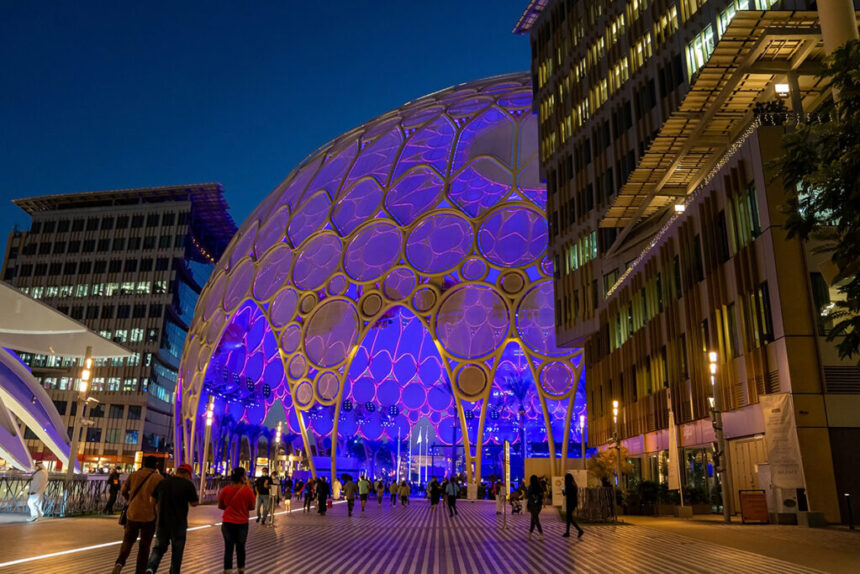
While thousands of people congregate each year in Expo City Dubai to revel in its attractions and venues, it has launched Terrazo—an avant-garde food donation and recovery scheme, which can approach the dilemma of food waste and, at the same time, collapse the distinction between blue-collar and white-collar workers on-site—all in a strategic response to two of modern urbanism’s most pressing problems: the over-disposal, underutilization, or unfair access to nourishment—and as a contribution to that long-term sustainability and social responsibility program of Expo City itself.
This ensures that quality surplus food is redistributed to the workers who are critical to running Expo City, modeling a sustainability practice that does not only take care of the environment but also prioritizes human well-being.
A Practical Solution to Global Food Waste Challenge
Food waste remains one of the biggest challenges in sustainability at a global level, especially in large hospitality and mixed-use developments wherein the generation of surplus appears to be standard. It is the class definition of fluctuating daily demand to allow adherence to strict food quality standards, and by overproducing, a good amount of edible food is disposed of often.
It is an evaluative and integrative operational solution to this effect between agreeing on safety and quality standards. Personnel in the restaurant set aside surplus meals for collection with the protocols specified by Terrazo. These then disappear into the collecting path for redistribution, again keeping within food safety-friendly practices and minimally interfering with restaurant partner operations.
The system converts a surplus from being an environmental liability to a societal resource, signifying an argument that targeted interventions can do tangible work without a substantial new infrastructure being required.
In the Daily Routine of Restaurants Going Green
Active and successful participation by the restaurant community at Expo City has been one of the most significant contributions to the early success of Terrazo. In fact, according to Mai Shalaby, Senior Manager of Sustainability of Expo City Dubai, most restaurants have now integrated Terrazo into their day-to-day working processes while being credited for both environmental and social benefits.
According to an Arabian Business interview with Shalaby, the initiative has clearly found most hospitality partners interested. Combined with providing translated waste reduction into social activities, Terrazo offers a pathway for restaurants to enhance their sustainability profile while at the same time enriching an inclusive urban ecosystem.
As a collaboration, this approach shares responsibility whereby businesses actively engage in contributing toward wider social and environmental objectives.
Advertising Healthy Food Access for Beneficiation of Workers
The blue-collar workers whom Terrazo works with during its entire mandate sometimes fall outside the ambit of sustainability initiatives. These workers constitute the backbone of Expo City Dubai and work in areas managed directly by it in terms of infrastructure, maintenance, logistics, and other essential services.
That is, Terrazzo will ensure that redistributed meals will be wholesome, freshly cooked, and of high quality—keeping within the principle that sustainability efforts can shine with dignity and respect. Food redistribution is not regarded as a charity act but viewed more with a sense of responsibility and an inclusive norm embracing all people in the community.
“More than waste management, Terrazo actually dignifies and cares for the workers who are an important part of our community,” Shalaby said.
Read Also –
AI Platforms Changing the World Market
Redefining Beach Weddings: Nuntă pe Plajă’s Ten Years of Excellence
Specific Goals and Measurable Objectives
For the pilot project, Terrazo has a target to redistribute more than 10,000 nutritious meals by September 2025. That in itself is quite an ambitious target for Expo City Dubai’s mark on responsibility and measurable effect.
The entire initiative is underway, prompting daily disposal of excess food from restaurants. As the number of participating restaurants grows, the number of reallocated meals will ramp up steadily, adding strength to the layers of Terrazo, delivering a sustainable and substantial benefit to society.
But Terrazo will measure not only its immediate impact but also mine data on trends of food wastage and patterns of consumption. It will thus inform the framing of future sustainability interventions and contribute to a broader narrative on food security and waste minimization.
Reinforcing Beyond Expo 2020 Vision of Expo City Dubai
The vision of Expo City Dubai includes Terrazo as a part of its urban development living laboratory for sustainable innovation post-expo. This venue is turning out to be a city of the future after the Expo 2020 Dubai is concluded, embedding sustainability and inclusivity into the very DNA of future cities as well as innovation.
In keeping with principles of the circular economy, Terrazo creates a closed-loop food system, thus maximizing existing resource use while minimizing waste generation. The initiative reinforces Expo City’s broader vision of developing scalable real-world interventions to jointly address environmental and social challenges.
Awareness within Industry Circles
Terrrazo is much more than a simple meal recovery project—it indeed is an educational platform raising awareness about food waste and responsible consumption. Direct involvement of restaurants further positions Terrazo into advocacy for better planning, responsible producing, and resource use.
Thus, partner-engaged businesses help to raise their profile at CSR and jointly engage in sustainability. Terrazo is a surprise case study, at the end of the day, of the interplay of urbanism and private ventures coming up with real, beneficial solutions.
As time goes by, the initiative is expected to create ripples across the business landscape, extending more profound effects to like-minded endeavors across many more developments and cities.
A Sustainable Model for Urban Communities
Terrazo would be, among other things, a proof of concept for inspiring and replicable novelties that tackled food insecurity as well as environmental constraints in cities around the world. Collaboration, operational feasibility, and measurable impact are key to its sustainability.
It’s by this that Expo City Dubai repositions itself as a thought leader in the field of sustainable urban development through Terrazo. With the initiative of collecting surplus food from waste and transforming it back into food and care, it really is a demonstration that design and common commitment can turn what appears to be a temporary problem into lasting social value.
Terrazo would be, among other things, a powerful proof of concept for inspiring, scalable, and replicable innovations that address food insecurity while responding to the environmental constraints faced by cities around the world. As urban populations continue to grow and resources become increasingly strained, initiatives like Terrazo demonstrate how thoughtful systems design can bridge the gap between surplus and need. By focusing on collaboration, operational feasibility, and measurable impact, the initiative establishes a practical framework that ensures long-term sustainability rather than short-lived solutions. These core principles allow Terrazo to function not only as a local program but also as a model that can be adapted and implemented in diverse urban contexts globally.
Through Terrazo, Expo City Dubai strategically repositions itself as a forward-thinking thought leader in sustainable urban development. The initiative reflects a broader vision in which cities are no longer passive consumers of resources but active innovators capable of regenerating social and environmental value. By collecting surplus food that would otherwise go to waste and transforming it into nutritious meals and essential care, Terrazo highlights how intentional design and collective commitment can redefine urban responsibility.
More importantly, Terrazo illustrates that challenges often perceived as temporary or unavoidable—such as food waste and insecurity—can be converted into opportunities for lasting social impact. It demonstrates how partnerships between institutions, communities, and operational stakeholders can create resilient systems that deliver dignity, nourishment, and care. In doing so, Expo City Dubai reinforces the idea that sustainability is not merely an environmental goal but a human-centered strategy for building more equitable, compassionate, and future-ready cities.
Beyond its immediate outcomes, Terrazo represents a shift in mindset around how cities can confront complex social and environmental challenges simultaneously. Rather than treating food waste and food insecurity as separate issues, the initiative integrates them into a single, efficient solution that maximizes existing resources. This holistic approach reduces landfill pressure, lowers carbon emissions associated with wasted food, and ensures that surplus is redirected to those who need it most. In doing so, Terrazo reinforces the importance of systems thinking in urban sustainability—where every stage of the supply chain is viewed as an opportunity for positive intervention.
The initiative also emphasizes the role of data, transparency, and accountability in driving meaningful change. By tracking food recovery volumes, distribution efficiency, and social outcomes, Terrazo enables measurable impact that can inform policy decisions and future urban planning strategies. These insights help demonstrate the tangible benefits of sustainable design, encouraging governments, private organizations, and communities to invest in similar models.
Moreover, Terrazo fosters a culture of shared responsibility, bringing together food providers, logistics partners, volunteers, and beneficiaries in a unified effort. This collaborative ecosystem strengthens community ties and builds trust, ensuring that sustainability efforts are inclusive and people-centered. As cities worldwide search for practical solutions to mounting environmental pressures, Terrazo stands as a compelling example of how innovation, empathy, and coordinated action can transform surplus into resilience and waste into opportunity.

